 Java
InterfacesDCE
Client ObjectDCE
Server ObjectBack to Java
Developer GuideBack to User Guide Java
InterfacesDCE
Client ObjectDCE
Server ObjectBack to Java
Developer GuideBack to User Guide
|
 Java Interfaces
1.The interface used for 'Java class for DCE node' is infinity.common.action.GAction.java, and its content is as follows:
package infinity.common.action;
import infinity.common.server.*;
import infinity.common.*;
import infinity.client.*;
import infinity.server.*;
/**
* This interface is used to be an action interface.
* An action class is used with the scheduler, which execute the perform() of each
* action according to the predefined schedule.
* To implement this interface, please notice that the constructor must
* be a constructor without any parameter, or it will encounter instantiationException
* in the instantiation stage.
* To compile the action class, the classpath should include the 'infinity.jar' file.
* By default, there is no main() method in this class, however, it can be added to
* its subclass if you want to run it alone as an application.
*/
public interface GAction {
/** To get the action name. The action name is a brief description about this action.
@return The default return value can be "undefined".
*/
public String getActionName();
/** for status or statistics or anything
could be csv or anything
*/
public String getInfo();
/** To get the version of the action class.
@return The default return value can be "undefined".
*/
public String getVersion();
/** To get the version date of the action class.
@return The default return value can be "undefined".
*/
public String getVersionDate();
/**
* This method usually called by the system's scheduler.
* If the subclass is intended to be a thread, can use these codes:
* t=new Thread(this);
* t.start();
* when override this method.
* If this method wants to share Weber, Net,and Connection with the command()
* method, can use these codes:
* this.dceClient=dceClient; this.dceServer=dceServer; this.c=c;
* when override this method.
* @param mode0 A original type of this command, produced by system.
* If a user calls this method directly, can set this to 0.
* @param modeNow A current type of this command, produced by system.
* If a user calls this method directly, can set this to 0.
* @param commandid An id of this command, produced by system.
* If a user calls this method directly, can set this to null.
* @param filler A string used by system.
* If a user calls this method directly, can set this to null.
* @param w The client object, produced by system.
* If a user calls this method directly, can set this to null.
* @param gs The server object, produced by system.
* If a user calls this method directly, can set this to null.
* @param parameters An array that represents the parameters for this perform.
* @param c The connection to the server, produced by system.
* If a user calls this method directly, can set this to null.
* @param scheduleItemId The id of the schedule item. This used when need to record the perform result or to control the schedule item,
* for example, a schedule item has a perform count limit or time limit.
*/
public boolean perform(int mode0,int modeNow,String originalId,String scheduleItemId,Weber dceClient,Net dceServer,String parameters[],infinity.common.server.Connection c);
/**
* This method usually called by using the client command.
* If this method wants to share dceClient, dceServer,and Connection with the perform()
* method, can use these codes:
* this.dceClient=dceClient; this.dceServer=dceServer; this.c=c;
* when override this method.
* @param mode0 A original type of this command, produced by system.
* If a user calls this method directly, can set this to 0.
* @param modeNow A current type of this command, produced by system.
* If a user calls this method directly, can set this to 0.
* @param mode A type of this command, produced by system.
* If a user calls this method directly, can set this to null.
* @param commandid An id of this command, produced by system.
* If a user calls this method directly, can set this to null.
* @param filler A string used by system.
* If a user calls this method directly, can set this to null.
* @param w The client object, produced by system.
* If a user calls this method directly, can set this to null.
* @param gs The server object, produced by system.
* If a user calls this method directly, can set this to null.
* @param cmd The command string represents the parameters of the command,
* each parameter separated by space, for example, "john 232 good day".
* when override this method, use
* StringTokenizer st=new StringTokenizer(cmd," "); to parse the command.
* @param c The connection to the server, produced by system.
* If a user calls this method directly, can set this to null.
*/
public boolean command(int mode0,int modeNow,String originalId,String scheduleItemId,Weber dceClient,Net dceServer,String cmd,infinity.common.server.Connection c);//
/**
* This method usually called for object processing.
* If the subclass is intended to be a thread, can use these codes:
* t=new Thread(this);
* t.start();
* when override this method.
* If this method wants to share Weber, Net,and Connection with the command()
* method, can use these codes:
* this.dceClient=dceClient; this.dceServer=dceServer; this.c=c;
* when override this method.
* @param mode0 A original type of this command, produced by system.
* If a user calls this method directly, can set this to 0.
* @param modeNow A current type of this command, produced by system.
* If a user calls this method directly, can set this to 0.
* @param commandid An id of this command, produced by system.
* If a user calls this method directly, can set this to null.
* @param filler A string used by system.
* If a user calls this method directly, can set this to null.
* @param w The client object, produced by system.
* If a user calls this method directly, can set this to null.
* @param gs The server object, produced by system.
* If a user calls this method directly, can set this to null.
* @param parameters An array that represents the parameters for this perform.
* @param obj An Object as a parameter for this perform.
* @param c The connection to the server, produced by system.
If a user calls this method directly, can set this to null.
*/
public boolean commandObj(int mode0,int modeNow,String originalId,Weber dceClient,Net dceServer,String parameters[],Obj obj,infinity.common.server.ServerObjectThread sot);
public boolean commandObj2(int mode0,int modeNow,String originalId,Weber dceClient,Net dceServer,String parameters[],Obj obj,infinity.common.server.ServerObjectThread2 sot);
public boolean commandObj3(int mode0,int modeNow,String originalId,Weber dceClient,Net dceServer,String parameters[],Obj obj,infinity.common.server.ServerObjectThread3 sot);
/**
* The parameter definition of this is the same as command().
* The difference between command() and msg() is that msg() can be called without authorized code.
*/
public boolean msg(int mode0,int modeNow,String originalId,String scheduleItemId,Weber dceClient,Net dceServer,String cmd,infinity.common.server.Connection c);//
/**
* The parameter definition of this method is the same as commandObj().
* The difference between commandObj() and msgObj() is that msgObj() can be called without authorized code.
*/
public boolean msgObj(int mode0,int modeNow,String originalId,Weber dceClient,Net dceServer,String parameters[],Obj obj,infinity.common.server.ServerObjectThread sot);
public boolean msgObj2(int mode0,int modeNow,String originalId,Weber dceClient,Net dceServer,String parameters[],Obj obj,infinity.common.server.ServerObjectThread2 sot);
public boolean msgObj3(int mode0,int modeNow,String originalId,Weber dceClient,Net dceServer,String parameters[],Obj obj,infinity.common.server.ServerObjectThread3 sot);
/**
* This method will be called where the grid status changed.
* For example, this method will be called when one node in or one node out..
*/
public void gridChanged(Weber dceClient, Net dceServer,int from);
/**
* To stop the running thread 't'.
* Subclass don't have to override this method, this method can be called directly.
*/
public void killThread();
/**
* To check if the thread t is sleeping or not.
* @return If this thread (if the subclass also implement Runable interface) is sleeping, return true.
*/
public boolean isSleep();
/**
* To check if the thread is null or not.
* @return If this thread (if the subclass also implement Runable interface) is null, return true.
*/
public boolean isNull();
/**
* To check if the thread 't' is alive or not.
* A thread is alive if it has been started and has not yet died.
* @return If the thread 't' is alive, return true.
*/
public boolean isAlive();
/**
* To get the status of this action class.
* @return The status of this action class, including the action name, version,
* version date, Thread 't' status, and so on.
*/
public String getStatus();/
/**
* To get the usage help of this class.
* @return The help of this action. Default is an empty string.
*/
public String getHelp();
/** To get the output format of the action.
@return 1, if the output is in html format. 0, if not in html format. The defautl return value is "0".
*/
public String getHtmlOutput();
/** To get the html title, this can be put as the headline of the html-result,
@return The default return value can be null or "undefined".
*/
public String getHtmlTitle();
/** To get the Style for the html result. The value format is "<style>.....</style>".
@return The default return value can be "".
*/
public String getStyle();
/** To get the javascript for the html result. The value is the text between "<script><!--" and "--></script>".
@return The default return value can be "".
*/
public String getJScript();
/** To get the html result.
@return The default return value can be "".
*/
public String getHtmlResult();
/** To get the menu title for hyperlink.
@return The default return value can be "undefined".
*/
public String getMenuTitle();
/**
#.dceClient.ap.onExit() should not been put within this method, or will cause infinite loop error. Because dceClient.ap.onExit() will call this method,
So one should call dceClient.ap.onExit() only outside this method.
#.window closing() should not call this method, window closing() show call dceClient.ap.onExit().
#.System.exit() should not put within this method, because dceClient.ap.onExit() will execute System.exit().
*/
public void onExit(int type);
/**
* @param apId, is id of this class.
* @param status, 2=already is updated version. 3=new version found.
* @param version, updated version value.
*/
public void informVersion(String apId,int status,String version);
}
Code example:
package ci_demo;
import infinity.common.Obj;
public class DCEHello implements GAction {
public String getActionName(){return "demo01";}
public String getInfo(){return "":}
public String getVersion() {return "1.0";}
public String getVersionDate(){return '20260903";}
public boolean perform(int mode0,int modeNow,String originalId,String scheduleItemId,Weber dceClient,Net dceServer,String parameters[],infinity.common.server.Connection c){
System.out.println("Hello world!");
dceClient.sendToOne("performcommand DCEHello Hello world!", dceClient.getGNS(38));
dceClient.sendToAll("performcommand DCEHello Hello world!");
Obj obj=new Obj("performactionobject DCEHello","Hello world!");
dceClient.sendObjToOne(obj, dceClient.getGNS(38));
dceClient.sendObjToAll(obj);
return true;
}
public boolean command(int mode0,int modeNow,String originalId,String scheduleItemId,Weber dceClient,Net dceServer,String cmd,infinity.common.server.Connection c){
return true;
}
public boolean commandObj(int mode0,int modeNow,String originalId,Weber dceClient,Net dceServer,String parameters[],Obj obj,infinity.common.server.ServerObjectThread sot){
return true;
}
public boolean commandObj2(int mode0,int modeNow,String originalId,Weber dceClient,Net dceServer,String parameters[],Obj obj,infinity.common.server.ServerObjectThread2 sot){
return true;
}
public boolean commandObj3(int mode0,int modeNow,String originalId,Weber dceClient,Net dceServer,String parameters[],Obj obj,infinity.common.server.ServerObjectThread3 sot){
return true;
}
public boolean msg(int mode0,int modeNow,String originalId,String scheduleItemId,Weber dceClient,Net dceServer,String cmd,infinity.common.server.Connection c){
return true;
}
public boolean msgObj(int mode0,int modeNow,String originalId,Weber dceClient,Net dceServer,String parameters[],Obj obj,infinity.common.server.ServerObjectThread sot){
return true;
}
public boolean msgObj2(int mode0,int modeNow,String originalId,Weber dceClient,Net dceServer,String parameters[],Obj obj,infinity.common.server.ServerObjectThread2 sot){
retrun true;
}
public boolean msgObj3(int mode0,int modeNow,String originalId,Weber dceClient,Net dceServer,String parameters[],Obj obj,infinity.common.server.ServerObjectThread3 sot){
return true;
}
public void gridChanged(Weber dceClient, Net dceServer,int from){}
public void killThread(){}
public boolean isSleep(){ return false; }
public boolean isNull(){return false; }
public boolean isAlive(){return true; }
public String getStatus(){return ""; }
public String getHelp(){return "";}
public String getHtmlOutput(return "0"; )
public String getHtmlTitle(){teturn "demo01";}
public String getStyle(){return ""; }
public String getJScript(){return ""; }
public String getHtmlResult(){return ""; };
public String getMenuTitle(){return "";}
public void onExit(int type){}
public void informVersion(String apId,int status,String version){}
}
Usage example:
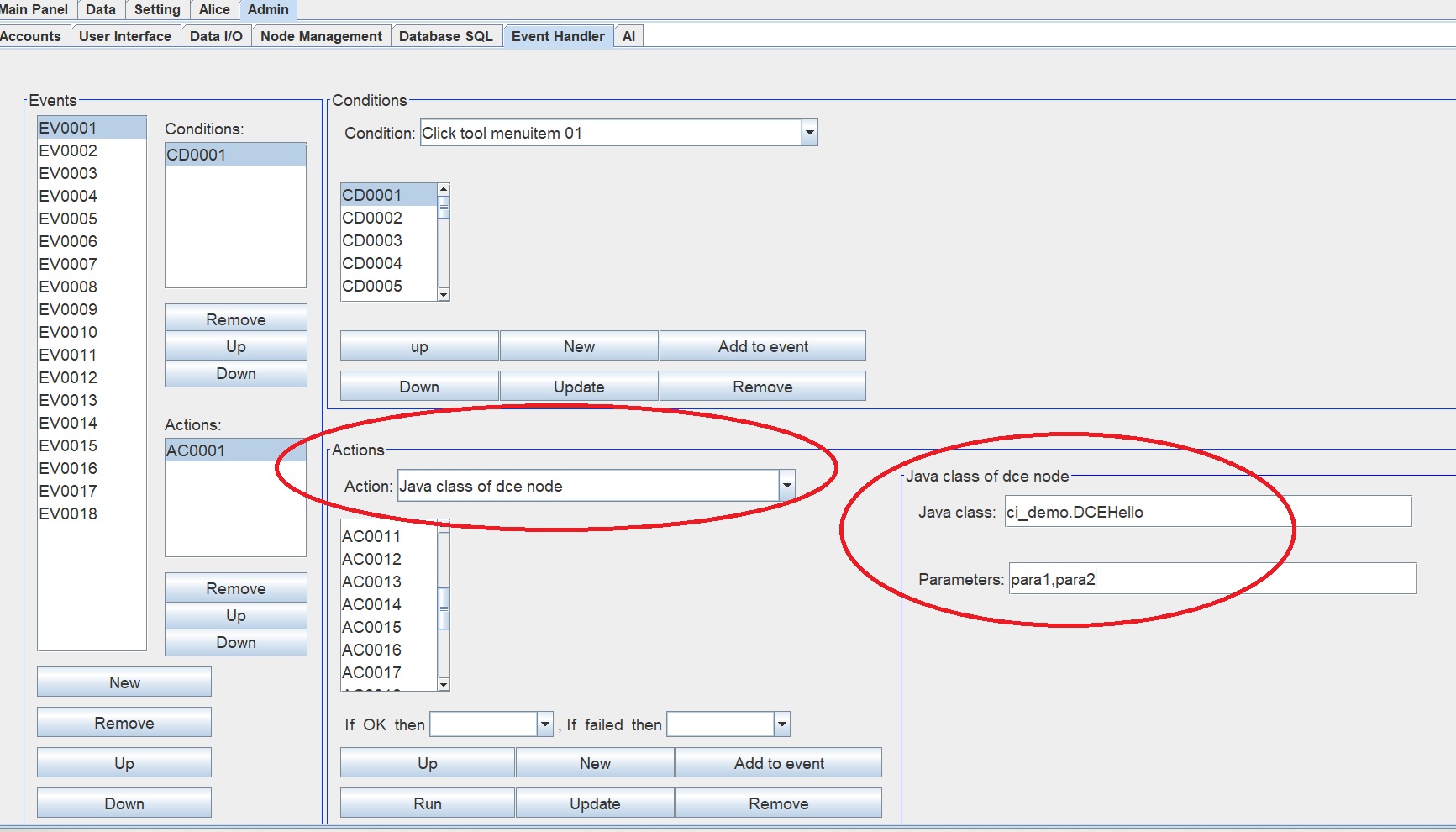
This will call the perform(int mode0,int modeNow,String originalId,String scheduleItemId,Weber dceClient,Net dceServer,String parameters[],infinity.common.server.Connection c) method in GAction.java.
.DCE Client Object1.Java class infinity.client.Weber as DCE client object
2.Usage example (method perform() within GAction class):
public boolean perform(int mode0,int modeNow,String originalId,String scheduleItemId,Weber dceClient,Net dceServer,String parameters[],infinity.common.server.Connection c){
dceClient.sendToOne("performcommand DCEHello Hello world!", dceClient.getGNS(38));
dceClient.sendToAll("performcommand DCEHello Hello world!");
Obj obj=new Obj("performactionobject DCEHello","Hello world!");
dceClient.sendObjToOne(obj, dceClient.getGNS(38));
dceClient.sendObjToAll(obj);
String myID=dceClient.getGNS(1);
String gns[]=dceClient.getGNS();
return true;
}
3.Parameters used in DCE client object:
String gns[] definitions:
gns[0]=system starttime (value in long))
gns[1]=my id
gns[2]=dce server version
gns[3]=dce client version
gns[4]=undefined
gns[5]=undefined
gns[6]=my ip
gns[7]=my port
gns[8]=undefined
gns[9]=undefined
gns[10]=computer name
gns[11]=group name
gns[12]=the server objport that I connect to
gns[13] ~ gns[26] = undefined
gns[27]=nick name in group as a member
gns[28]=connection limit
gns[29]=undefined
gns[30]=the server ip that I connect to
gns[31]=the server port that I connect to
gns[32] ~ gns[37] = undefined
gns[38]=the server id that I connect to
gns[39]=my objectport2
gns[40]=the server objectport2 that I connect to
gns[41]=my objectport3
gns[42]=the server objectport3 that I connect to
gns[43]=undefined
gns[44]=top server id
gns[45]=top server ip
gns[46]=top server port
.DCE Server Object1.Java class infinity.server.Net as DCE server object
2.Usage example (method perform() within GAction class):
public boolean perform(int mode0,int modeNow,String originalId,String scheduleItemId,Weber dceClient,Net dceServer,String parameters[],infinity.common.server.Connection c){
String cmdcode="code234";
String pid=dceClient.getPid(cmdcode);
infinity.common.server.Connection connections[]=dceServer.getConnections(pid);
for(int i=0;i<connections.length;i++){
String cgns[]=connections[i].getCGNS();
String connectionID=cgns[0];
String computername=cgns[1];
System.out.println("Connection "+i+": id="+connectionID+", computername="+computername);
}
return true;
}
3.Parameters used in each connection of DCE server object:
String cgns[] definitions:
cgns[0]=id
cgns[1]=computername
cgns[2] ~ [6] = undefined
cgns[7]=ip
cgns[8]=port
cgns[9]=undefined
cgns[10]=undefined
cgns[11]=nick name
cgns[12] ~ [15] = undefined
cgns[16]=group name